 By Nick Irmo
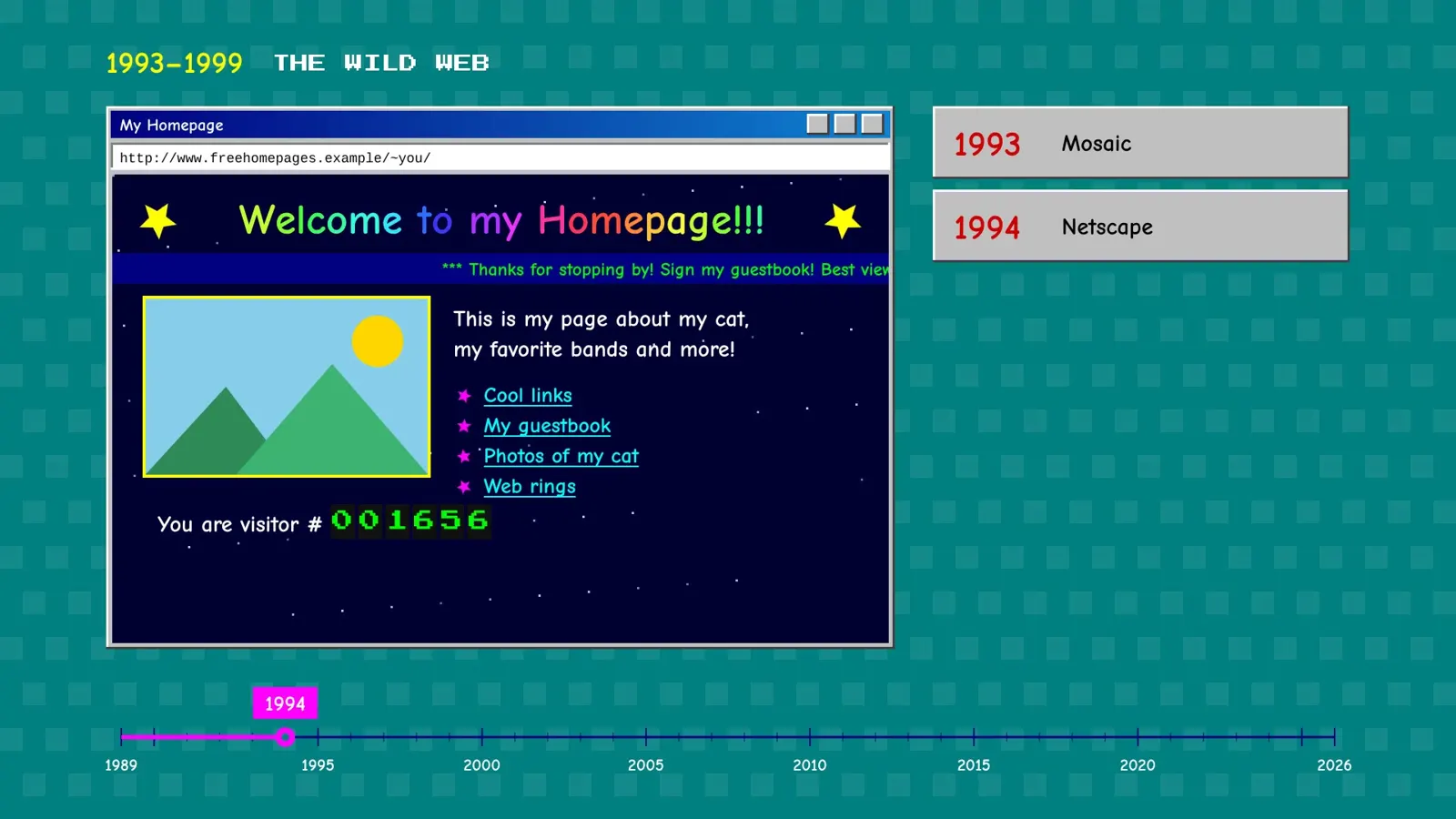
Web design has gone from one page of blue links to sites built in a conversation in about 35 years. The first website went live at CERN in 1991. Since then, design has moved through table layouts and Flash intros, the CSS and web standards era, glossy Web 2.0, responsive and flat design, app-like sites built with frameworks, and now AI-built sites and AI search. Our narrated video walks the whole timeline in just over three minutes.
Chapters
| Time | Era | Years |
|---|---|---|
| 0:00 | Cold open | |
| 0:10 | The text web | 1989 to 1992 |
| 0:33 | The wild web | 1993 to 1999 |
| 1:12 | The standards web | 2000 to 2006 |
| 1:38 | The social and mobile web | 2004 to 2012 |
| 2:08 | The app web | 2013 to 2022 |
| 2:40 | The AI web | 2023 to today |
| 3:02 | Close |
Key milestones in web design
| Year | Milestone | Why it mattered |
|---|---|---|
| 1989 | Tim Berners-Lee proposes the web at CERN | The idea of linked documents across computers |
| 1991 | The first website goes live | Text and links, no images or layout |
| 1993 | Mosaic browser | Images shown alongside text |
| 1994 | Netscape Navigator | The web goes mainstream; everyone wants a homepage |
| 1996 | Flash and CSS level 1 | Animation arrives; style starts to separate from content |
| 1998 | Google founded | Search becomes the front door to every business |
| 2003 | WordPress launches | Anyone can publish without code |
| 2007 | iPhone | The full web in your pocket |
| 2010 | Responsive web design | One site that adapts to every screen |
| 2013 | Flat design and React | Simpler visuals; sites start behaving like apps |
| 2020 | Flash end of life | HTML5, CSS3 and JavaScript take over completely |
| 2023 on | AI builders and AI search | Sites built from prompts; answers summarized from websites |
The eras in short
The text web (1989 to 1992)
The first websites were plain documents. Black text, blue underlined links and nothing else. Design was not the point: getting information one click away was.
The wild web (1993 to 1999)
Browsers like Mosaic and Netscape brought images and a flood of personal homepages. With almost no design tools, people used HTML tables to force layouts, and free hosts like GeoCities filled the web with animated GIFs, visitor counters and under-construction banners. Flash added intros and sound. CSS arrived in 1996, but browsers took years to support it well.
The standards web (2000 to 2006)
Designers moved layout out of tables and into CSS, and the web standards movement pushed for sites that worked the same in every browser. Google made search visibility a business priority, and WordPress made publishing easy. For more on that platform today, see WordPress for blogs and content.
The social and mobile web (2004 to 2012)
Web 2.0 brought glossy buttons, gradients and sites built around sharing. The iPhone changed everything in 2007. After a few years of separate mobile sites, responsive design gave us one layout that reshapes itself for any screen, and Flash faded as HTML5 and CSS3 took over.
The app web (2013 to 2022)
Flat design stripped away the gloss. Frameworks like React made websites behave like apps, builders like Squarespace, Wix and Shopify let small businesses launch quickly, and hosts like Netlify and Vercel made fast static sites easy to ship. Accessibility, guided by the WCAG standards, became an expectation. See our guide to website accessibility, ADA and WCAG for where that stands now.
The AI web (2023 to today)
AI can now draft copy, generate images and write working code from a plain-English request, and AI assistants answer questions by summarizing websites. We cover building this way in how to build a website with Claude and getting found in AI answers in optimizing an AI-built site for search and AI.
See the data side of the story
Two companion animations show how the tools behind these eras rose and fell from 2015 to 2026: website platform popularity, covering WordPress, Shopify, Wix and others, and web language popularity, covering PHP, JavaScript, Ruby and the end of Flash.
Transcript
Every website you've ever visited sits on top of more than thirty-five years of experiments, accidents, and big ideas. Let's scroll through them.
In 1989, Tim Berners-Lee, a scientist at CERN, proposed a way to link documents across computers. By 1991, the first website was live: black text, blue links, and a page explaining what the World Wide Web was. No images. No layout. Just information, one click away.
Then came Mosaic in 1993, the browser that put images right alongside text. Netscape followed in 1994, and suddenly, everyone wanted a homepage. Designers had almost no tools, so they got creative. Tables became page layouts. GeoCities gave millions of people free pages, complete with animated GIFs, visitor counters, and under-construction signs. In 1996, Flash arrived, bringing intros, animation, and sound, whether you wanted them or not. CSS was introduced the same year, but browsers took years to support it properly.
In the 2000s, the web grew up. Designers moved layouts out of tables and into CSS, and the web standards movement pushed sites to work the same in every browser. Google, founded in 1998, became the front door to every business, and search optimization became a profession. Then, in 2003, WordPress launched. Now anyone could publish without touching code.
Web 2.0 brought glossy buttons, rounded corners, and sites built around what people shared. Then, in 2007, the iPhone put the full web in our pockets. Separate mobile sites came first. In 2010, Ethan Marcotte offered a better answer: responsive web design. One site that reshapes itself for any screen. Meanwhile, Flash faded, and HTML5 and CSS3 took over the effects it used to handle.
In 2013, Apple's iOS 7 helped make flat design the default: bold color, simple icons, and plenty of white space. Facebook released React that same year, and websites started behaving like apps. Builders like Squarespace, Wix, and Shopify let small businesses launch in a weekend, while hosts like Netlify and Vercel made fast, secure sites easier to ship. And accessibility, guided by the WCAG standards, moved from nice-to-have to expected.
Now, the tools are changing again. AI can draft copy, create images, and write working code from a plain-English request. Search is shifting too, as AI assistants answer questions by summarizing websites instead of just listing them. Clear structure, useful content, and real expertise matter more than ever.
From one page of blue links to websites built in a conversation, the web keeps changing. The goal hasn't: help people find what they need. Planning your next website? Irmo Web Design can help.
Sources
- CERN: A short history of the Web
- W3C: CSS level 1 recommendation, December 1996
- WordPress.org: History
- A List Apart: Responsive Web Design, Ethan Marcotte, 2010
- Adobe: Flash Player end of life
Ready for a site that fits this era? Talk to us.
Questions people ask
When was the first website created?
When did CSS come out?
Who invented responsive web design?
When did Flash stop working?
What comes next in web design?
Planning a website?
Get a platform recommendation and a fixed quote within one business day.