 By Nick Irmo
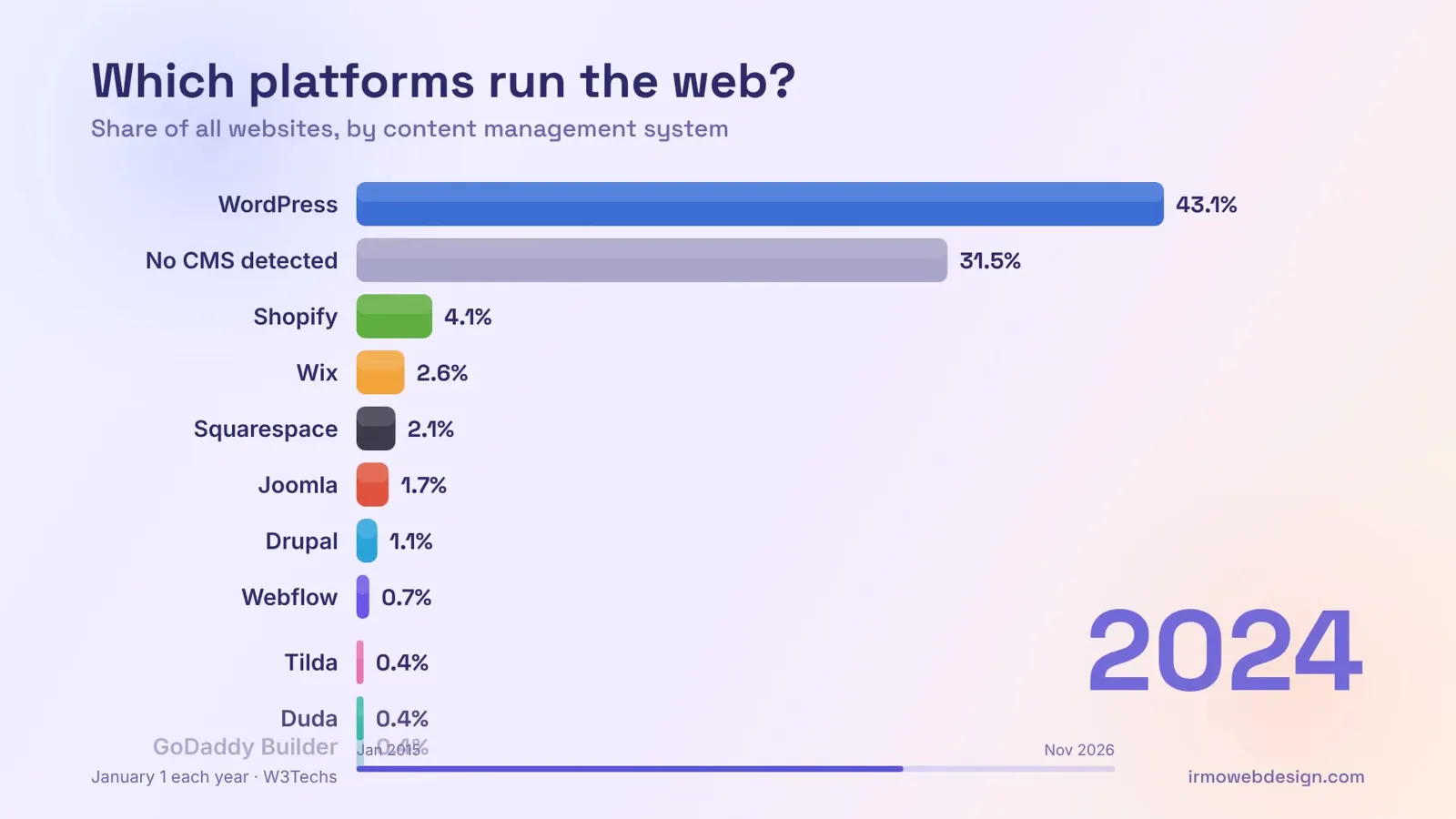
WordPress runs the web, but hosted builders are where the growth is. According to W3Techs, WordPress was on 23.3% of all websites in January 2015 and 39.4% on November 8, 2026. Over the same period Shopify grew from 0.3% to 5.3%, Wix from 0.1% to 4.2% and Squarespace from 0.2% to 2.4%, while Joomla and Drupal shrank. The biggest change of all is the drop in sites with no content management system, from 61.7% to 32.2%.
The animation below shows the race year by year.
The numbers behind the animation
W3Techs scans the top 10 million websites and records which content management system, if any, each one uses. These figures are the share of all websites in that sample.
| Platform | Jan 2015 | Jan 2020 | Nov 2026 | Change since 2015 |
|---|---|---|---|---|
| No CMS detected | 61.7% | 43.1% | 32.2% | -29.5 pts |
| WordPress | 23.3% | 35.4% | 39.4% | +16.1 pts |
| Shopify | 0.3% | 1.9% | 5.3% | +5.0 pts |
| Wix | 0.1% | 1.3% | 4.2% | +4.1 pts |
| Squarespace | 0.2% | 1.5% | 2.4% | +2.2 pts |
| Joomla | 3.3% | 2.6% | 1.1% | -2.2 pts |
| Webflow | not listed | 0.1% | 0.8% | |
| Tilda | not listed | 0.1% | 0.8% | |
| Duda | 0.1% | 0.1% | 0.7% | +0.6 pts |
| Drupal | 2.0% | 1.7% | 0.6% | -1.4 pts |
| GoDaddy Website Builder | 0.1% | 0.2% | 0.6% | +0.5 pts |
Source: W3Techs, content management systems, yearly trends.
Looking only at sites that use a detectable CMS, WordPress's share is even larger: 39.4% out of 67.8% works out to roughly 58%, by our calculation from the W3Techs figures.
What is driving the changes
Fewer hand-coded sites
In 2015, most websites in the sample had no detectable CMS: they were hand-coded, built on custom systems or too old to classify. By 2026 that group had shrunk by almost half. Businesses that once paid a developer to edit every page moved to platforms that let staff update content themselves. That shift is the main reason every platform on the chart grew at the same time.
WordPress: the default choice
WordPress picked up most of those sites. It is free, open source, runs on almost any host and has a plugin or theme for nearly everything. Its growth slowed after 2022, and W3Techs shows a dip in 2026 that may partly reflect detection changes (see the FAQ). It is still the platform behind about four in ten websites. If you are on WordPress, hosting and maintenance matter most; see the best WordPress hosting and WordPress security hardening.
Shopify: commerce moved to hosted platforms
Shopify's climb from 0.3% to 5.3% is the clearest commerce story on the chart. Store owners traded self-managed carts for a hosted platform that handles payments, security and checkout. We explain why most businesses should do the same in why you should probably use a platform for ecommerce, and compare the options in Shopify vs BigCommerce vs WooCommerce.
Wix, Squarespace and the one-click builders
Wix, Squarespace, Duda, Tilda and GoDaddy's builder all grew because they made launching a site fast and cheap for small businesses and solo owners. The trade-off is less control and a monthly fee that never ends. Our series on one-click website builders and platform licensing fees covers when that trade-off is worth it, and Squarespace for small business looks at one builder closely.
Webflow: the designer's builder
Webflow grew from not listed to 0.8%. It sits between builders and custom code, giving designers fine control without writing everything by hand. See Webflow for design-led sites.
Joomla and Drupal: steady decline
Joomla and Drupal were big names in the 2000s, when open source CMS options were few. Both still have active communities and power large sites, especially in government and higher education for Drupal. But their share has fallen by roughly two thirds since 2015 as WordPress and hosted builders took the small business market.
Platforms decide your language too
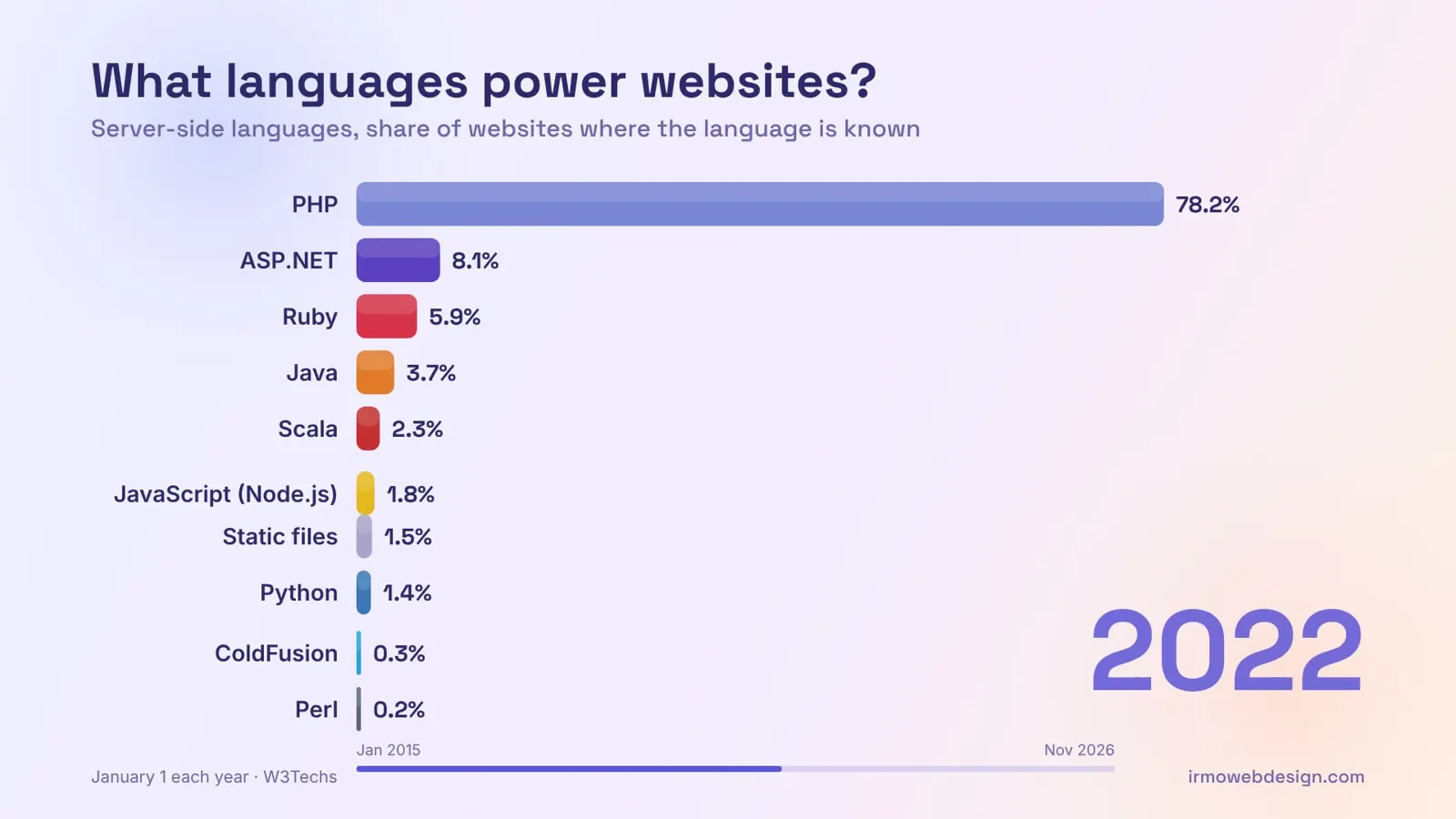
Every platform brings a programming language with it: WordPress, Joomla and Drupal run on PHP, Shopify runs on Ruby, and custom builds often use JavaScript. Our companion animation on web language popularity shows the same shifts from the code side, including PHP's slow slide and the rise of JavaScript on the server.
To check what a specific site runs on, see how to find out what platform a website is built on.
What this means for your next website
- Popular is not the same as right. WordPress is a safe default, but the best platform depends on your goals, budget and who will maintain the site. Start with how to choose a website platform.
- Selling online? Use a commerce platform. The data shows store owners moving to Shopify and similar hosted systems for good reasons.
- Weigh builders against long-term cost. Builders are quick to launch, but compare the monthly fees over three to five years with a one-time build.
- On Joomla or Drupal with a small team? It may be time to plan a migration while your site still works well. Our guide to redesigning without losing SEO covers how to move safely.
About the data
All figures come from W3Techs historical yearly trends, which record usage on January 1 each year, plus a snapshot on November 8, 2026, when we accessed the page. W3Techs measures the top 10 million sites by traffic, not every site on the internet, and its numbers can shift when its detection methods change. Platforms that did not appear in a given year are shown as zero in the animation. The launch years in the animation's intro (Drupal 2001, WordPress 2003, Squarespace 2004, Joomla 2005, Shopify 2006, Wix 2006, Webflow 2013) are widely documented release dates.
Not sure which platform fits your business? Talk to us.
Questions people ask
What is the most popular website platform?
What share of websites don't use a CMS at all?
Which website platforms are growing fastest?
Are Joomla and Drupal dying?
Why did WordPress drop in 2026?
Planning a website?
Get a platform recommendation and a fixed quote within one business day.