 By Nick Irmo
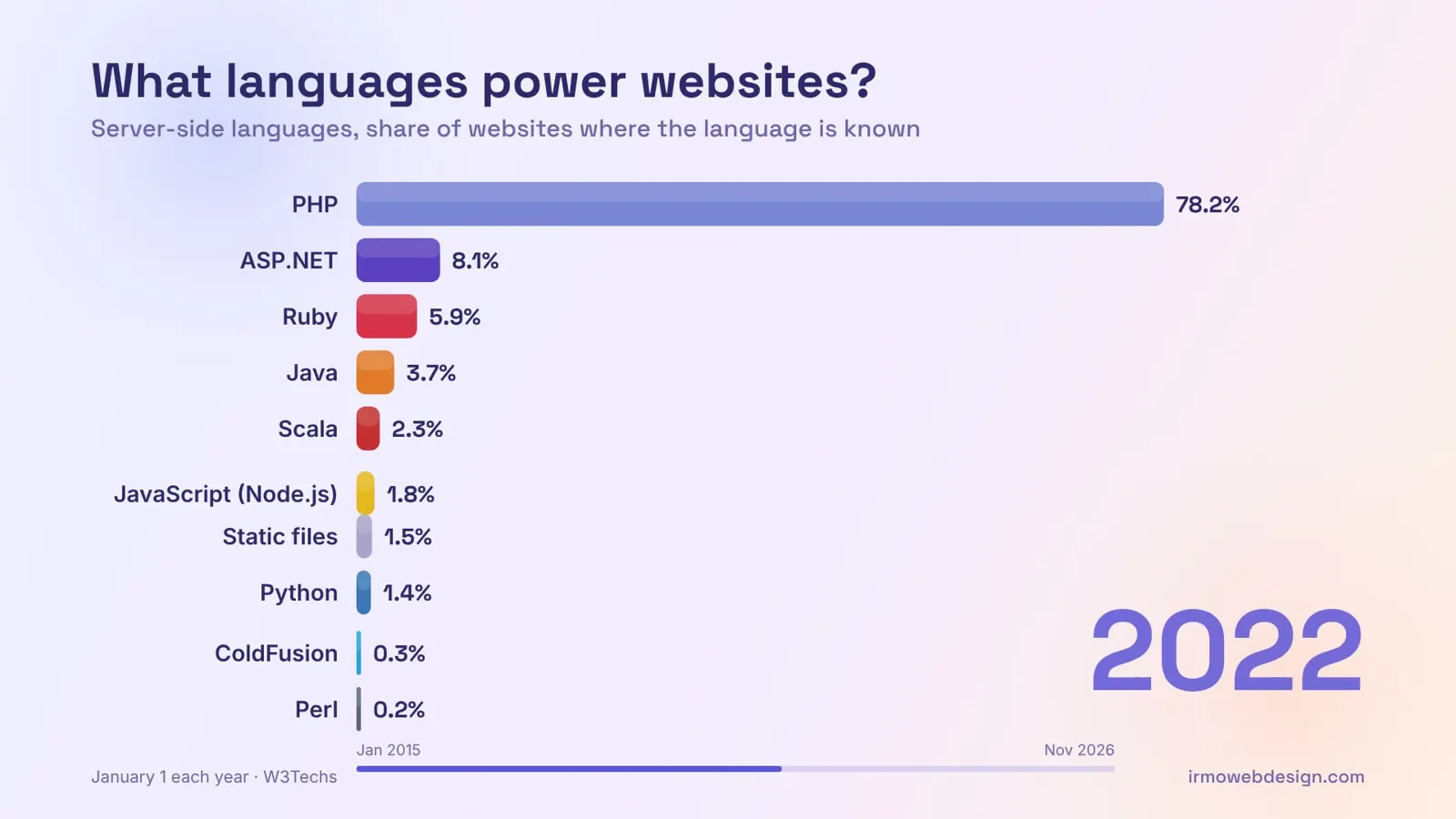
PHP still powers most websites, but its lead is shrinking. According to W3Techs, PHP ran on 80.6% of websites with a known server-side language in January 2015 and 69.0% on November 8, 2026. Over the same period JavaScript on the server (Node.js) grew from 0.1% to 8.4%, Ruby from 0.9% to 7.1%, and ASP.NET fell from 16.7% to 4.2%. In the browser, JavaScript is close to universal at 98.9% of all websites, while Flash, once on 12.1% of sites, is effectively gone.
The animation below shows the whole race year by year.
The numbers behind the animation
W3Techs scans the top 10 million websites and reports which technologies it can detect. The server-side figures are the share of sites where the server-side language is known, and a site can use more than one language, so columns can add up to slightly more than 100%.
| Server-side language | Jan 2015 | Jan 2020 | Nov 2026 | Change since 2015 |
|---|---|---|---|---|
| PHP | 80.6% | 78.9% | 69.0% | -11.6 pts |
| JavaScript (Node.js) | 0.1% | 0.8% | 8.4% | +8.3 pts |
| Ruby | 0.9% | 3.0% | 7.1% | +6.2 pts |
| Java | 2.8% | 3.7% | 5.5% | +2.7 pts |
| Scala | 0.2% | 1.6% | 5.0% | +4.8 pts |
| ASP.NET | 16.7% | 10.6% | 4.2% | -12.5 pts |
| Static files | not listed | 1.8% | 2.1% | |
| Python | 1.6% | 1.3% | 1.1% | -0.5 pts |
Source: W3Techs, server-side languages, yearly trends.
| In the browser (share of all websites) | Jan 2015 | Jan 2020 | Nov 2026 |
|---|---|---|---|
| JavaScript | 88.1% | 95.0% | 98.9% |
| Flash | 12.1% | 2.8% | 2.8% |
Source: W3Techs, client-side languages, yearly trends.
What is driving the changes
PHP: carried by WordPress
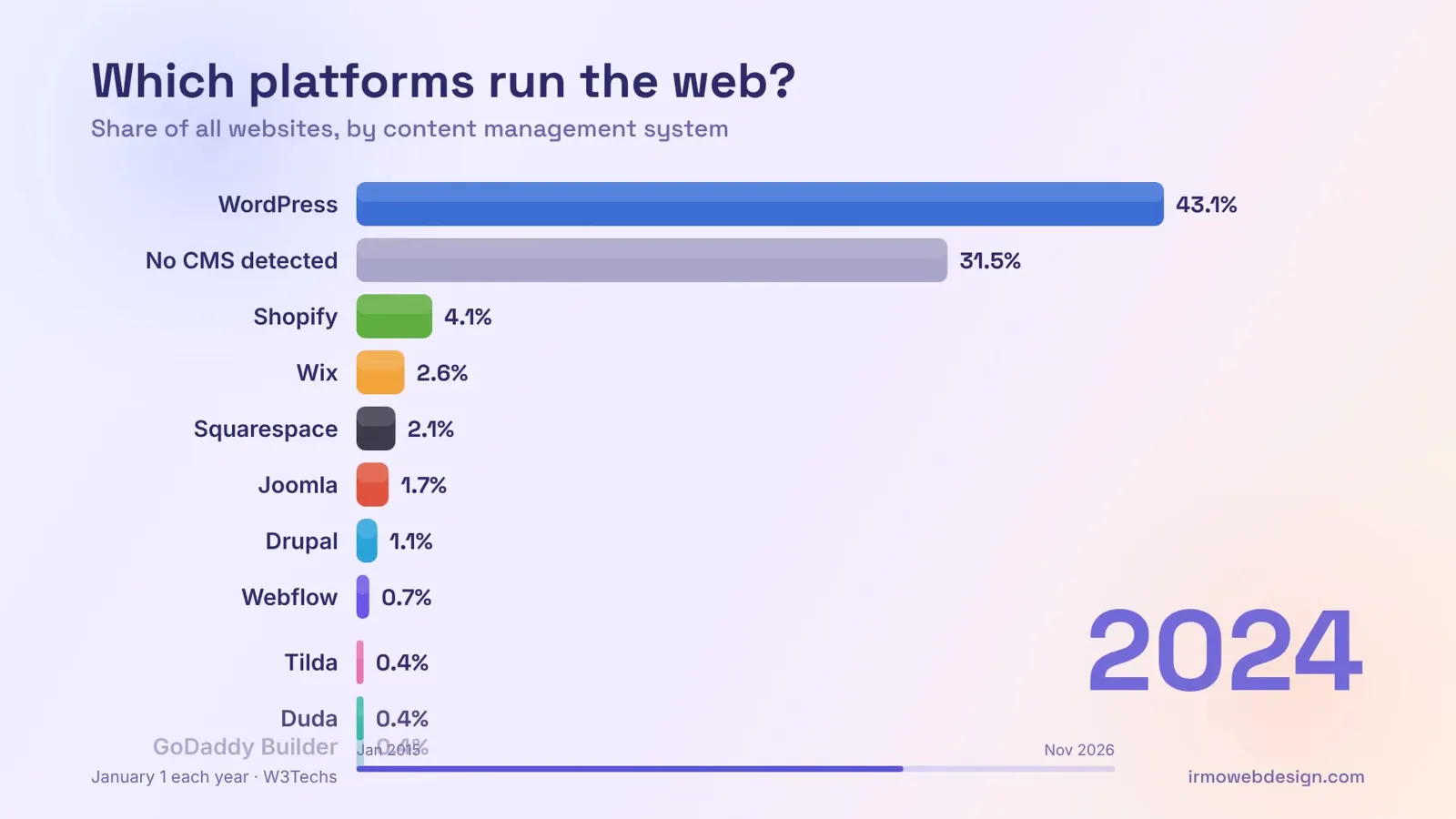
PHP's staying power is mostly a WordPress story. WordPress is written in PHP, and our companion animation of website platform popularity shows WordPress growing from 23.3% to 39.4% of all websites over the same years. As long as WordPress runs that much of the web, PHP will stay on top. The slow decline reflects sites moving to hosted builders and newer frameworks, not people abandoning PHP for its own sake.
JavaScript on the server: the fastest riser
JavaScript started as the language of the browser in 1995. Node.js, released in 2009, let developers run it on the server too. Since then, frameworks such as Next.js have made it practical to build a whole site, front end and back end, in one language. That convenience is a big reason Node.js went from almost nothing to 8.4%. It is also the stack we use for many custom builds; see why we use Next.js for business websites.
Ruby and Scala: riding on hosted platforms
Ruby's growth lines up with hosted platforms. Shopify, for example, is built on Ruby on Rails, so every Shopify store W3Techs detects can count toward Ruby. Scala's rise is likely similar: it is used behind the scenes by large website builders rather than chosen by individual site owners. In other words, many business owners "use" Ruby or Scala without ever writing a line of it. Our guide to Shopify for growing brands covers that platform in detail.
ASP.NET: the biggest decline
ASP.NET was a common choice for custom business sites in the 2000s, especially for companies already on Microsoft servers. Its share fell by about three quarters between 2015 and 2026. The data does not explain why, but the pattern matches what we see in redesign projects: older custom .NET sites are often replaced with WordPress, a site builder or a modern framework when they come up for a rebuild.
Flash: from everywhere to end of life
Flash once powered intros, animations and whole websites. Browsers dropped support, and Adobe ended Flash Player support on December 31, 2020. Its share fell from 12.1% of sites in 2015 to 1.0% in January 2025. W3Techs shows a small uptick to 2.8% in late 2026, which most likely reflects leftover embed code on old pages rather than anything that still plays. Every browser effect Flash once handled is now done with HTML, CSS and JavaScript.
Platforms and languages are linked
Most site owners never pick a programming language directly. They pick a platform, and the platform brings its language with it. That is why this chart and our website platform chart tell the same story from two angles.
Our companion post on website platform popularity has the matching animation for WordPress, Shopify, Wix and the rest.
| If you choose | You are mostly using |
|---|---|
| WordPress, Joomla, Drupal | PHP |
| Shopify | Ruby (on Shopify's servers) |
| Next.js or another JavaScript framework | JavaScript or TypeScript |
| Wix, Squarespace and other builders | Whatever the vendor runs; you never touch it |
| A static site | HTML, CSS and JavaScript, built ahead of time |
Curious what a competitor's site runs on? Our guide on how to find out what platform a website is built on walks through the tools and clues.
What this means for your next website
- Don't choose a language, choose a platform. The language matters to your developer; the platform decides your costs, flexibility and how easily you can make changes. Start with how to choose a website platform.
- PHP is not a red flag. A well-built, well-hosted WordPress site is a solid choice for most small and mid-size businesses. Hosting matters more than the language; see the best WordPress hosting.
- JavaScript frameworks suit custom needs. If you want top speed, a unique design or a headless CMS, a framework like Next.js is worth the higher build cost.
- Old ASP.NET or Flash-era sites are due. If your site still depends on technology from the decline lines on this chart, plan a rebuild before something breaks.
About the data
All figures come from W3Techs historical yearly trends, which record usage on January 1 each year, plus a snapshot on November 8, 2026, when we accessed the pages. W3Techs measures the top 10 million sites by traffic, not every site on the internet, and its numbers can shift when its detection methods change. Use it for direction and scale, not exact counts. The launch years in the animation's intro (JavaScript 1995, PHP 1995, Java 1995, ASP 1996, ASP.NET 2002, Ruby on Rails 2004, Node.js 2009) are widely documented release dates.
Want help picking the right platform, or moving off an aging one? Talk to us.
Questions people ask
What is the most popular programming language for websites?
Is PHP dying?
Why did ASP.NET decline so much?
Are HTML and CSS programming languages?
Which language should my business website use?
Planning a website?
Get a platform recommendation and a fixed quote within one business day.